before the novel opens
A Robot Takes Vince’s Job
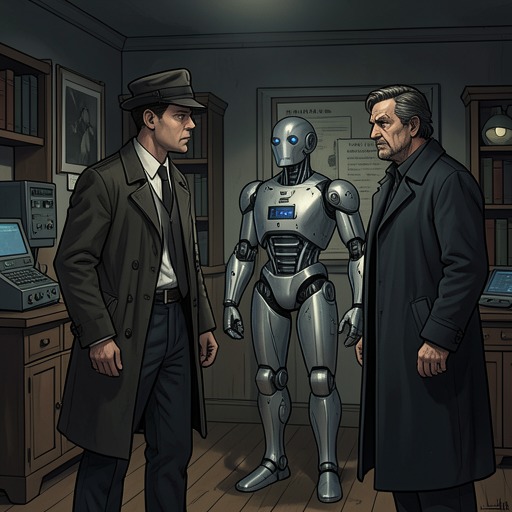
R. Sami replaced the young Vince Barrett in the police department, forcing him to take a delivery job at a yeast farm. This unemployment gave people a face to their fear of robots taking jobs and causing people to fall in the city rating system; this fear also surrounded Ilias Bela's assignment
three days before the opening
The Spacer Murder Revealed
A blaster killed [Roj Nemennuh Sarton](entity:character-recall-character-roj-nemennuh-sarton-f4c412e5dd57), an [Aurora](entity:location-recall-location-aurora-34947b30effd) sociologist living in [Spacetown](entity:location-recall-location-spacetown-5c0c262c5f76). The killing threatened to turn longstanding hostility between [Earth](entity:location-recall-location-earth-a6b883af9147) and the [Outer Worlds](entity:location-recall-location-outer-worlds-7652b8c31eeb) into a diplomatic crisis, with the prospect of indemnities or harsher consequences for Earth.
the opening day, morning
Enderby Recruits Baley
[Julius Enderby](entity:character-recall-character-julius-enderby-6b76d6503a4a) summoned [Elijah Baley](entity:character-recall-character-elijah-baley-89d5871196ee) and explained that the [Terrestrial Bureau of Investigation](entity:organization-recall-organization-terrestrial-bure-0cd7d4fdb224) would not take charge: [Spacetown](entity:location-recall-location-spacetown-5c0c262c5f76) was within New York jurisdiction, and the crisis had fallen on the city police. The only safe political course, he argued, was to find the killer themselves and hand the culprit over.
the opening day, morning
A Promotion with Conditions
Enderby promised Baley a chance at a higher rating if he led the investigation, but revealed the condition imposed by the Spacers: Baley must work with one of their agents. The partner would be a robot who would live in Baley’s apartment, leaving Baley to persuade Jessie to accept an arrangement he already knew would distress her.
the opening day, later that morning
Daneel at Spacetown Approach
Baley traveled to the [Spacetown](entity:location-recall-location-spacetown-5c0c262c5f76) approach expecting to meet a Spacer and discovered that the composed, human-looking man waiting there was [R. Daneel Olivaw](entity:character-recall-character-r-daneel-olivaw-f2738d5500c0), a robot. Daneel explained that his humanlike design was deliberate, intended to let him enter [Earth](entity:location-recall-location-earth-a6b883af9147) society without provoking immediate hostility.
the opening day, late morning
The Partner’s Equal Rating
On the expressway, Baley initially assumed Daneel could not use the upper level because he was a robot. Daneel produced credentials with a C-5 rating, establishing that the investigation required the partners to travel as equals in the city’s formal system, even while Baley struggled to accept him as a colleague.
the opening day, around midday
A Crowd Gathers at the Shoe Store
Near Baley’s home, a crowd had gathered outside a shoe department because customers objected to robot clerks. The dispute expressed a deeper fear that robots would take human jobs and leave families vulnerable to declassification, a fear Baley understood through memories of his own father’s fall in status.
the opening day, around midday
Daneel Disperses the Mob
Inside the store, Daneel ordered the force door opened and then mounted a display to threaten the crowd with a blaster. He claimed he would shoot, although he was incapable of harming a human, and the bluff worked: the crowd dispersed without a riot. Baley concealed Daneel’s role from the responding police, then angrily warned him never to threaten people that way again.
the opening day, afternoon
Baley Faces His Family
Baley brought Daneel to the family apartment, where Jessie and Bentley first treated the robot as a human visitor. Jessie’s nervous hospitality and Bentley’s fascination with robot bookfilms made Baley acutely aware of how Daneel’s presence unsettled domestic life, even as the investigation temporarily slipped from his mind.
the opening day, evening
Jessie Recognizes the Robot
After Jessie had heard talk of a human-looking Spacer robot working with the police, she returned home and identified Daneel as a robot. Her sudden fear revealed that information about his presence had already circulated beyond the few people who officially knew the arrangement.
the first night
Daneel Searches the Personal
After Baley and Jessie went to bed, Daneel left their apartment to investigate whether someone had spybeamed their private conversation. He suspected the leak identifying him as a robot came from surveillance, and searched the nearby men’s Personal, where custom protected privacy, but found no transmitter.
the first night, before sleep
Baley Suspects a Spacetown Plot
Baley decided that the rumor about Daneel was evidence of a Spacer conspiracy designed to provoke anti-robot violence and justify intervention on [Earth](entity:location-recall-location-earth-a6b883af9147). His fear and distrust briefly turned the investigation away from the actual crime and toward an imagined plan for occupation.
the second day, morning
Enderby Resists the Spacetown Visit
Baley told Enderby that he intended to visit [Spacetown](entity:location-recall-location-spacetown-5c0c262c5f76) and inspect the murder scene. Enderby tried to dissuade him, but Baley secured a trimensional connection so the Commissioner could witness the meeting from a safe distance, reflecting Baley’s growing suspicion that the case could turn dangerous.
the second day, late morning
Baley Enters Spacetown
At [Spacetown](entity:location-recall-location-spacetown-5c0c262c5f76)’s entrance, Baley underwent disinfection, a shower, and a blood test before being told to leave his blaster behind. The quarantine procedures, which he experienced as humiliating, were grounded in the genuine disease vulnerability of the Spacers, who lacked Earthmen’s acquired resistance.
the second day, midday
Fastolfe Explains the Project
[Han Fastolfe](entity:character-recall-character-han-fastolfe-ac3c819b4fdc) welcomed Baley and explained why [Spacetown](entity:location-recall-location-spacetown-5c0c262c5f76) had created humanoid robots: [Roj Nemennuh Sarton](entity:character-recall-character-roj-nemennuh-sarton-f4c412e5dd57) hoped robots could enter [Earth](entity:location-recall-location-earth-a6b883af9147)’s cities and help the Spacers understand Earth society. Sarton believed that a blended C/Fe culture might help Earth escape its overcrowded city system and help the stagnant [Outer Worlds](entity:location-recall-location-outer-worlds-7652b8c31eeb) resume expansion.
the second day, midday
The Colonization Argument
Fastolfe argued that [Earth](entity:location-recall-location-earth-a6b883af9147)’s immense cities depended on fragile flows of power, water, air, and food, while the Spacer worlds faced the opposite problem of underpopulation and excessive stability. He proposed that Earthmen could pioneer new planets with robot assistance, creating societies that combined cooperation with initiative rather than repeating either civilization’s failures.
the second day, early afternoon
Baley Accuses Daneel of Being Sarton
Before Fastolfe and Enderby, Baley announced that Sarton was alive and pointed to Daneel, arguing that the supposed corpse had been a robot. He built his case from Daneel’s humanlike body, his apparent violation of the First Law in the shoe-store incident, and his claim to possess a justice drive.
the second day, early afternoon
Daneel’s Robot Body Revealed
Fastolfe challenged Baley to inspect Daneel rather than rely on inference. Daneel opened his arm to expose metal mechanisms beneath synthetic skin, conclusively demonstrating that he was a robot and that the body shown as Sarton’s could not simply be dismissed as an imposture.
the second day, afternoon
Fastolfe Explains Spacer Isolation
After Baley recovered from the shock, Fastolfe explained that Spacers kept their distance from Earthmen because ordinary [Earth](entity:location-recall-location-earth-a6b883af9147) diseases could kill them, not because they considered themselves superior. Their careful separation concealed a vulnerability that their political prestige made difficult to admit publicly.
the second day, afternoon
Fastolfe Describes Two Civilizational Crises
Fastolfe outlined the opposed dangers facing [Earth](entity:location-recall-location-earth-a6b883af9147) and the [Outer Worlds](entity:location-recall-location-outer-worlds-7652b8c31eeb): Earth’s growing population and dependence on city infrastructure, and the Spacers’ long lives, low birth rates, and reluctance to risk new settlement. He argued that new colonies could renew both societies, though Baley remained wary of the proposal.
the second day, afternoon
Baley Learns Enderby Was a Suspect
On the return journey, Daneel disclosed that Enderby had been the sole Earthman present at the crime scene and was therefore the first suspect. He had been cleared because no blaster was found in his possession or in [Spacetown](entity:location-recall-location-spacetown-5c0c262c5f76), and cerebroanalysis indicated that he was psychologically incapable of deliberate murder.
the second day, late afternoon
The Commissioner Denies Cerebroanalysis
Back at the [Department](entity:organization-recall-organization-department-aa8c2cf59185), Baley questioned Enderby about Spacer colonization plans and the analysis of his brain. Enderby claimed not to know what cerebroanalysis was, while Daneel later explained that he himself had performed it without the Commissioner’s awareness, resolving the apparent contradiction without clearing Enderby of every suspicion.
the second day, evening
Daneel Identifies the Kitchen Watchers
Baley took Daneel to a section kitchen, where Daneel noticed that several diners were watching them, including men from the shoe-store crowd. Baley realized the watchers might be tracking the pair, and chose to leave carefully rather than arrest them in a crowded room and risk igniting a riot.
the second day, evening
Baley Runs the Strips
Baley used his childhood skill at running the moving strips to shake the pursuers, with Daneel keeping pace through the city’s transit flows. After a rough crossing of a moving platform, Daneel lifted Baley before he could fall into a dangerous human pileup, and the partners reached a power plant where they could break their trail.
the second day, evening
Baley Moves His Family to Safety
Baley settled Daneel and himself in a low-grade temporary apartment, then admitted Bentley when the boy arrived, sent by Jessie because she feared for Baley’s safety. Rather than send his son into the corridors again, Baley contacted Jessie himself and insisted that Bentley remain with him overnight.
the third day, morning
Gerrigel Rejects the Robot Murder Theory
[Anthony Gerrigel](entity:character-recall-character-anthony-gerrigel-bb00a9cf593a), a leading [Earth](entity:location-recall-location-earth-a6b883af9147) roboticist, met Baley in an insulated conference room. He explained that a robot built under the Three Laws could not murder a human being and that designing a brain without those laws would require a foundational theory not known to Earth robotics.
the third day, morning
Gerrigel Recognizes Daneel
As the discussion turned to whether a robot could pass for human, Gerrigel finally realized that Daneel was a robot and eagerly asked to examine him. Baley used the discovery to press his theory that a humanoid robot might have a brain unlike ordinary [Earth](entity:location-recall-location-earth-a6b883af9147) models, but Gerrigel insisted Daneel was governed by the First Law.
the third day, late morning
The Blaster Is Shown Unloaded
Baley argued that Daneel could have killed Sarton because he had been at the scene and could have concealed the missing weapon in his artificial food sac. Daneel answered by showing that his blaster had never been charged, explaining how he had threatened the shoe-store crowd without any possibility of firing.
the third day, midday
Vince Seeks Help
After Gerrigel’s examination, Vince Barrett returned to the [Department](entity:organization-recall-organization-department-aa8c2cf59185) hoping Baley could help him regain a job. Baley could offer little more than sympathy as Vince described rumors that even a human performer might secretly be a robot, while his own case embodied the employment anxiety driving anti-robot sentiment.
the third day, afternoon
Daneel Detects Baley’s Inner Conflict
Daneel told Baley that his cerebroanalysis revealed a conflict between professional duty and a strong reluctance to pursue the suspected conspirators. Baley dismissed the [Medievalists](entity:organization-recall-organization-medievalists-5fefc6a9bdd2) as harmless romantics, but Daneel questioned why Jessie had recognized him as a robot when no general rumor could be found.
the third day, afternoon
Daneel Questions Jessie’s Warning
Daniel inferred that Jessie sent Bentley to Belie because she thought she might be recognized or put in danger, which shows that she knows more about those who threaten them than she admits. Belie is unwilling to accept this conclusion, but this reasoning clearly indicates that Jessie's fear is related to an organized group
the third day, afternoon
Jessie Confesses Her Membership
Jessie came to the [Department](entity:organization-recall-organization-department-aa8c2cf59185) in distress and admitted that she had joined a local [Medievalist](entity:character-recall-character-c1fd958d65a9) group after reconsidering Baley’s account of the biblical Jezebel and the conflict between old and new ways. Her meetings involved speeches, oaths, and talk of future resistance, but she insisted she had never taken part in violence.
the third day, afternoon
Jessie Describes the Underground Meetings
Jessie said the local group met in little-used passages of the city motorways, where dozens gathered for speeches and refreshments. She believed the gatherings were harmless until members began speaking of coordinated action against robots and the government, making her fear that the movement might turn violent.
the third day, afternoon
Clousarr Identified by the Yeast Smell
When Daneel described suspected members, Jessie could not recognize faces but recalled a speaker whose clothing carried the smell of raw yeast. That sensory detail led the investigators toward [Francis Clousarr](entity:character-recall-character-francis-clousarr-b41106129efe), a yeast specialist whose workplace and history of anti-robot agitation made him a plausible lead.
the third day, late afternoon
Baley Protects Jessie from the Report
Baley took Jessie and Bentley to safety and refused to include her name in the report, despite Daneel’s insistence that a complete account mattered. Their disagreement exposed the tension between exacting legal justice and personal mercy, a conflict Baley illustrated by recounting the biblical story of the accused woman spared from stoning.
the third day, late afternoon
Baley Confronts Clousarr
Baley and Daneel went to [New York Yeast](entity:location-recall-location-new-york-yeast-63013bc925b7) in [Yeast-town](entity:location-recall-location-yeast-town-4d2858dd877c) and questioned [Francis Clousarr](entity:character-recall-character-francis-clousarr-b41106129efe), who had no convincing alibi for the nights surrounding the shoe-store incident. Clousarr admitted his commitment to returning humanity to the soil and rejected colonization as another Spacer scheme, while Baley argued that emigration to other planets could give [Earth](entity:location-recall-location-earth-a6b883af9147)’s population a future.
the third day, early evening
Clousarr Strikes Daneel
Baley provoked Clousarr by asking Daneel to place an arm around him, and Clousarr recoiled in hatred, identifying Daneel as a robot. After Clousarr struck Daneel, Baley arrested him and pressed him to explain the movement’s beliefs, while Clousarr insisted that robots threatened the livelihoods of his children and everyone else’s.
the third day, evening
R. Sammy Is Found Destroyed
Daneel returned with news that [R. Sammy](entity:character-recall-character-r-sammy-0f141a27244a) had been found in a photographic supply room with his positronic brain destroyed by an alphasprayer. Because the destruction had occurred inside the police department and the device came from a power plant, the incident raised the possibility of an inside job rather than ordinary anti-robot vandalism.
the third day, evening
Enderby Suspects Vince
Enderby treated [R. Sammy](entity:character-recall-character-r-sammy-0f141a27244a)’s destruction as deliberate sabotage and considered Vince Barrett a possible suspect because the robot had taken his job. Vince’s departure before the time R. Sammy was last heard alive weakened that theory, but the missing alphasprayer and the lack of an obvious motive left the department unsettled.
the third day, evening
Baley Sees Himself Framed
Baley realized that he himself had a motive for silencing [R. Sammy](entity:character-recall-character-r-sammy-0f141a27244a): the robot might have learned about Jessie’s secret membership and exposed her. The alphasprayer had been taken from the [Williamsburg power plant](entity:location-recall-location-williamsburg-power-p-bcbbcc8fe4f9), through which Baley and Daneel had traveled, giving someone a way to frame him with both motive and opportunity.
the third day, late evening
Spacetown Abandons the Case
Daneel told Baley that [Spacetown](entity:location-recall-location-spacetown-5c0c262c5f76) had decided to end the Sarton investigation and prepare to withdraw from [Earth](entity:location-recall-location-earth-a6b883af9147). He explained that the Spacer project had succeeded in identifying a native constituency open to colonization, and that continuing the case might obstruct the larger effort to redirect the [Medievalists](entity:organization-recall-organization-medievalists-5fefc6a9bdd2) toward new worlds.
the third day, around 22:30
Baley Extends the Deadline
Baley saw that the day was not yet over and persuaded Daneel that, as his partner, he must continue the investigation until midnight. Daneel accepted the literal argument, allowing Baley to obtain a three-dimensional microfilm of the murder scene before [Spacetown](entity:location-recall-location-spacetown-5c0c262c5f76)’s withdrawal decision took effect.
the third day, around 22:45
Enderby Moves Against Baley
Enderby confronted Baley with evidence that placed him at the [Williamsburg power plant](entity:location-recall-location-williamsburg-power-p-bcbbcc8fe4f9) and revealed that Clousarr had implicated Jessie in a subversive group. With a destroyed robot, a possible motive, and access to the missing weapon converging against Baley, the Commissioner appeared prepared to suspend or arrest his former friend.
the third day, around 23:00
Baley Accuses Enderby of the Frame
Baley refused to resign and accused Enderby of planting the evidence against him to stop the Sarton investigation. He reasoned that the murderer had to know he had passed through the power plant, then noticed that Enderby had supplied a detail about Jessie’s full name that Clousarr could not have known from her more recent identity.
the third day, shortly after 23:00
Enderby Is Exposed as the Informer
Baley concluded that Enderby had known Daneel’s identity and leaked it to the [Medievalists](entity:organization-recall-organization-medievalists-5fefc6a9bdd2), explaining how the shoe-store confrontation became a staged display of anti-robot feeling. He also inferred that Enderby had obtained the alphasprayer and arranged [R. Sammy](entity:character-recall-character-r-sammy-0f141a27244a)’s destruction to incriminate Baley and end the investigation.
the third day, around 23:40
Baley Reconstructs the Sarton Killing
Baley proposed that Enderby had entered [Spacetown](entity:location-recall-location-spacetown-5c0c262c5f76) intending to destroy Daneel, whom he mistook for a machine that could be sabotaged without committing murder. Without his glasses, Enderby mistook the real Sarton for Daneel and blasted him; the killing was accidental, which explained why Daneel’s cerebroanalysis had found him incapable of deliberate murder.
the third day, just before midnight
Glass Slivers Confirm the Accident
Baley used the murder-scene film to locate glints in the grooves of the dome door, then identified them as fragments from Enderby’s broken glasses. The evidence placed the Commissioner at the scene earlier than he had admitted and supported Baley’s reconstruction of the fatal mistake.
the third day, at midnight
Enderby Confesses
Confronted with the glass fragments, Enderby broke down and admitted that Sarton’s death had been a mistake. Baley secured Daneel’s confirmation that the Commissioner was not acting out of calculated cruelty, then offered a way forward: Enderby could help redirect the [Medievalists](entity:organization-recall-organization-medievalists-5fefc6a9bdd2) toward colonization rather than face immediate prosecution.
the novel’s final minutes
The R. Sammy Case Is Buried
Baley pressed Enderby to quash the inquiry into [R. Sammy](entity:character-recall-character-r-sammy-0f141a27244a)’s destruction, since the apparent sabotage had been used to frame him and endangered Jessie. Enderby agreed to cooperate with the Spacer plan, while Daneel assured Baley that the larger cause would take precedence over punishment for the lesser wrongs.
near the ending
Baley Trusts Daneel
Baley told Daneel that he trusted and admired him, and wondered whether the robot might remain on [Earth](entity:location-recall-location-earth-a6b883af9147) after [Spacetown](entity:location-recall-location-spacetown-5c0c262c5f76) withdrew. He imagined that Bentley could one day enter an emigrant training program and perhaps travel with Daneel, linking his family’s future to the possibility of planetary colonization.
the final scene
Daneel Learns About Mercy
Daneel reflected that transforming evil into good might be more just than simply destroying what was wrong, echoing the story Baley had told about mercy and forgiveness. He repeated the biblical injunction to go and sin no more, and Baley and the robot left the office together as partners rather than adversaries.